The packaging format you choose directly impacts product stability, consumer compliance, contamination risk, and brand perception. For pharmaceutical manufacturers, cosmetic brands, and personal care companies, the decision between unit dose packaging and multi-dose formats represents far more than container selection—it’s a strategic choice that affects efficacy, safety, and market positioning.
Understanding the technical and commercial implications of each approach enables informed decisions that align with product chemistry, target demographics, regulatory requirements, and business objectives.
Defining Unit Dose and Multi-Dose Packaging Formats
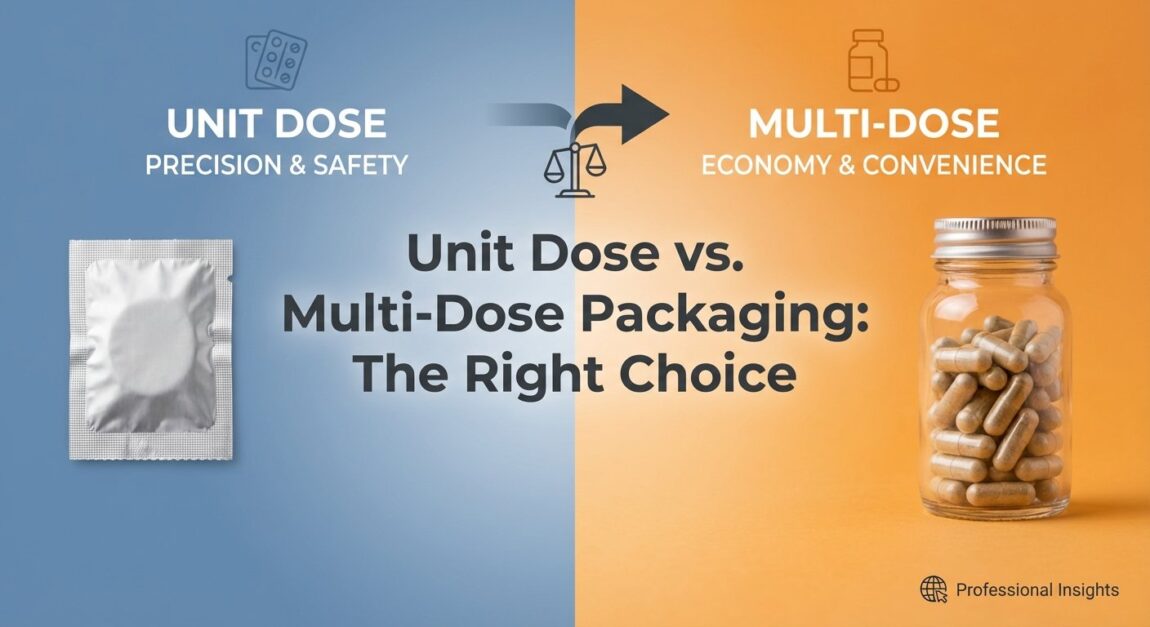
Single dose packaging contains precisely one application or treatment amount in an individually sealed container. These formats include ampoules, blister packs, sachets, single-use vials, and pod systems. Each package opens once and dispenses its complete contents in a single use.
Multi-dose packaging houses multiple applications in one container, designed for repeated access over days, weeks, or months. Common examples include bottles with droppers, tubes, jars, pump dispensers, and squeeze bottles with measured outputs.
The fundamental distinction lies in exposure patterns. Unit dose formats eliminate repeated environmental exposure, while multi-dose containers face ongoing contamination risks with each opening.
Product Integrity and Stability Advantages
Preservation Without Preservatives
Unit dose packaging allows formulation without preservative systems because contents never experience repeated microbial exposure. This proves particularly valuable for sensitive actives that oxidize rapidly or products targeting consumers seeking “clean” ingredient profiles.
Pharmaceutical packaging manufacturers increasingly leverage this advantage for vitamin C serums, retinoids, peptide formulations, and other oxidation-prone compounds. The hermetically sealed environment maintains potency from manufacturing through application.
Multi-dose formats require robust preservative systems to prevent microbial growth across weeks of use. This necessity adds formulation complexity, potential allergen exposure, and conflicts with clean beauty positioning.
Oxygen and Moisture Protection
Single dose packaging provides superior barrier protection against environmental degradation. Each dose remains isolated in its protective environment until the moment of use. For hygroscopic ingredients or moisture-sensitive actives, this protection proves essential.
Sterile eye drops, injectable medications, and premium skincare actives benefit substantially from this isolation. The packaging effectively extends product shelf life and guarantees consistent potency.
Multi-dose containers, even with advanced valve systems and airless technology, still permit some environmental exchange. While modern multi-dose packaging has improved dramatically, unit dose formats maintain the technical advantage for highly reactive formulations.
Regulatory and Compliance Considerations
Pharmaceutical products face stringent FDA regulations regarding sterility assurance, stability testing, and contamination prevention. Unit dose formats simplify compliance in several ways.
Sterility validation becomes more straightforward when terminal sterilization occurs after filling and sealing individual doses. Each unit undergoes identical processing with no variation in exposure time or sterilant penetration that can occur with multi-dose formats.
Contract filling services specializing in pharmaceutical applications typically maintain ISO Class 7 or Class 8 cleanroom environments for multi-dose filling, but unit dose operations in Class 8 environments can achieve equivalent or superior contamination control due to minimal exposure windows.
For over-the-counter medications, unit dose formats reduce post-market contamination complaints. The FDA scrutinizes consumer-use contamination patterns, and single-use formats eliminate a significant risk vector.
Documentation and Traceability
Lot tracking and recall management operate with greater precision using unit dose packaging. Each individual package carries complete lot information, expiration dates, and traceability codes. If quality issues emerge, recalls can target specific production runs with surgical precision.
Multi-dose containers provide batch-level traceability, but once opened and partially used, tracking becomes imperfect. This difference matters significantly in pharmaceutical applications where regulatory agencies demand comprehensive accountability.
Consumer Compliance and Usage Accuracy
Dosing accuracy represents a critical factor in therapeutic effectiveness and consumer satisfaction. Unit dose packaging eliminates guesswork—the package contains exactly the correct amount for one application.
Studies consistently demonstrate improved patient compliance with unit dose medications compared to multi-dose formats. The simplified instructions (“use one packet daily”) remove confusion about proper dosing and eliminate the risk of over- or under-application.
For cosmetic applications, this precision ensures consumers experience optimal results. A facial serum delivered in unit dose ampoules guarantees users apply the formulator’s intended amount rather than arbitrary quantities that may prove insufficient or wasteful.
Travel convenience further enhances compliance. Single dose packages slip easily into carry-on bags, gym bags, or purses without liquid restrictions or leakage concerns. This portability supports consistent use patterns that drive product performance and brand loyalty.
Cost Structures and Economic Considerations
The cost analysis between formats extends beyond material expenses to encompass manufacturing efficiency, waste reduction, and market positioning.
Manufacturing and Materials
Unit dose packaging typically incurs higher per-unit material costs due to increased packaging-to-product ratios. A single-dose sachet uses more packaging material per milliliter of product than a bottle containing thirty doses.
However, packaging innovation continues reducing this gap. High-speed pharmaceutical packaging manufacturers now achieve unit dose production rates exceeding 300 units per minute, improving cost efficiency through automation and scale.
Multi-dose packaging benefits from lower material costs per application but requires more sophisticated container systems—airless pumps, precision droppers, or metered valves—that can equal or exceed unit dose container costs.
Waste Reduction and Consumer Value
Multi-dose containers frequently suffer from product waste. Consumers cannot extract the final portions trapped in bottle shoulders, around pump mechanisms, or adhering to jar walls. Industry estimates suggest 15-25% of multi-dose product never reaches the consumer’s skin.
Unit dose formats eliminate this waste entirely. Every manufactured milliliter reaches the consumer, maximizing ingredient value and supporting sustainability messaging around product efficiency.
For premium formulations with expensive actives, this waste reduction can offset higher packaging costs while improving consumer value perception.
Market Positioning and Brand Differentiation
Packaging format communicates product positioning before consumers experience formulation benefits. Unit dose packaging signals precision, luxury, innovation, and scientific sophistication.
Premium skincare brands leverage single dose ampoules to create ritualistic experiences and emphasize ingredient freshness. The opening ceremony—snapping an ampoule or tearing a foil sachet—delivers tactile engagement that bottles cannot match.
Pharmaceutical brands use unit dose blister packs to communicate dosing clarity and professional-grade quality. The format itself becomes a trust signal indicating rigorous manufacturing standards and attention to therapeutic accuracy.
Contract filling services report growing demand from emerging brands seeking differentiation in crowded categories. Unit dose packaging provides immediate shelf distinction and creates shareable unboxing experiences that drive social media engagement.
Application-Specific Format Selection
When Unit Dose Excels
Single dose packaging proves optimal for:
- Oxidation-sensitive actives requiring fresh-opened protection
- Sterile pharmaceutical applications including eye drops and injectables
- Travel-size offerings and subscription box inclusions
- Sampling programs and professional distribution channels
- Products requiring precise dosing for efficacy or safety
- Formulations without preservatives targeting clean beauty consumers
- Premium positioning emphasizing freshness and potency
When Multi-Dose Makes Sense
Multi-dose formats suit products requiring:
- Variable application amounts based on individual needs
- Lower price points for mass market positioning
- Extended daily use where convenience outweighs preservation concerns
- Large format economy packaging
- Products with stable, preservative-tolerant formulations
- Applications where users prefer control over dispensed amounts
Hybrid Strategies and Emerging Innovations
Forward-thinking brands increasingly adopt portfolio approaches, offering both formats to address different consumer segments and use occasions.
A facial serum line might feature multi-dose bottles for home use and unit dose packets for travel or first-time trial. This strategy maximizes market coverage while optimizing format to context.
Packaging innovation continues blurring traditional distinctions. Airless multi-dose systems now approach unit dose contamination protection, while connected packaging technologies add smart features to both formats.
Biodegradable unit dose materials address environmental concerns that previously favored multi-dose formats from sustainability perspectives. These developments enable brands to capture unit dose benefits while meeting corporate environmental commitments.
Manufacturing Partnership Considerations
Selecting the appropriate format requires manufacturing capabilities that many brands lack in-house. Partnering with experienced contract filling services provides access to specialized equipment, cleanroom facilities, and regulatory expertise necessary for successful execution.
Established pharmaceutical packaging manufacturers maintain validated processes for both formats, enabling objective recommendations based on product characteristics rather than equipment limitations. This capability proves essential when exploring format options during product development.
Turnkey solutions encompassing formulation development, stability testing, package selection, filling operations, and quality assurance streamline the path from concept to market. Partners with comprehensive capabilities reduce coordination complexity and accelerate launch timelines.
Making the Strategic Decision
The unit dose versus multi-dose decision demands careful analysis of product chemistry, target consumer priorities, competitive positioning, regulatory requirements, and business objectives.
Start by evaluating formulation stability under repeated exposure conditions. Products failing multi-dose preservative challenge testing or showing rapid oxidation essentially require unit dose protection.
Consider your target consumer’s priorities. Professional channels and premium segments often value precision and freshness signals that unit dose packaging communicates, while mass market consumers may prioritize economy and convenience.
Analyze competitive positioning opportunities. If category leaders universally employ one format, the alternative may offer differentiation advantages that capture consumer attention and create positioning space.
Calculate total cost of ownership including material expenses, manufacturing efficiency, waste factors, and market price premiums each format commands. The apparent cost advantage of multi-dose packaging sometimes disappears under comprehensive analysis.
Partner with Packaging Expertise
Successfully navigating format selection and execution requires deep technical knowledge spanning formulation science, packaging engineering, regulatory compliance, and manufacturing operations. LF of America brings 35+ years of specialized experience helping brands make informed packaging decisions that balance technical requirements with commercial objectives.
Our cleanroom manufacturing facilities, comprehensive testing capabilities, and turnkey approach transform packaging decisions from overwhelming challenges into competitive advantages. Whether your product demands the precision of unit dose packaging or the practicality of multi-dose formats, our team provides the expertise and infrastructure to execute flawlessly.
Contact LF of America to discuss your specific product requirements and discover how the right packaging format can maximize efficacy, enhance consumer appeal, and accelerate your market success.